

What Does A High Pass Filter Do
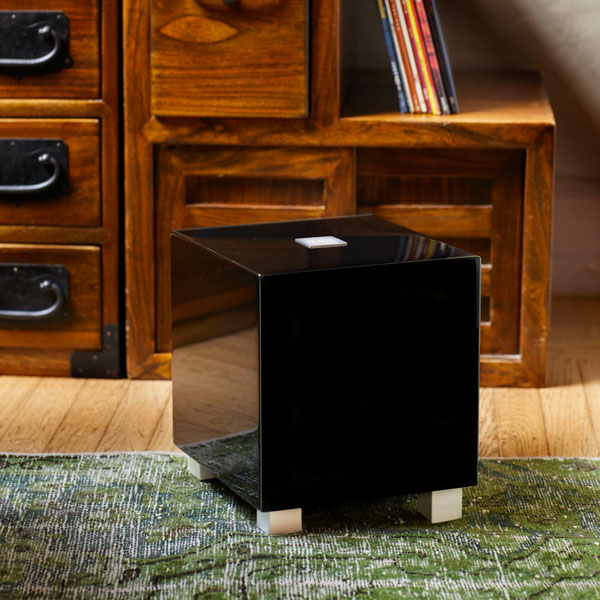
The first half of the question is piece of cake, the 2nd gets into some very of import idea almost what a subwoofer is and where information technology should get out off and your loudspeakers start earning their keep. REL thinks of this outcome differently and with more respect for the artists of all genres– the musical artists, the picture show sound engineers and the speaker designers who created your speaker– as uniquely gifted artists who bring you a truly magical experience. We'll become into more on that later in the postal service.
What Is A High Pass Filter And What Does It Do?
Let's starting time with, what is a High Pass Filter? Well, the name says it all, a High Pass Filter allows the higher frequencies to pass through. All audio systems begin with a Source component. Could be a CD player, these days it's more likely to be streamer, might fifty-fifty be a smart phone sending information via BlueTooth to your system. Any its origins—and for pure sound quality of the ones I listed, the better CD players and ship/DACs still provide the all-time sound by a significant margin – audio emerges from the source, travels through the electronic heart of your system to your speakers.
Even if you are unaware of them, receivers accept preamps and power amps within. Integrated amps only combine a preamp and stereo power amp into 1 chassis. Most of the highest quality systems have separate preamplifiers and power amplifiers, since that permits the greatest range of freedom to sculpt the audio exactly the way their owners want to hear it, since each component has its own sonic signature. From in that location, the sound travels downward speaker cables, Total RANGE, to your loudspeakers.
A High Pass Filter is inserted between the preamplifier and power amplifier—it lives in our competitor'south subwoofers–– and it cuts out the bass. Beginning, let me make the argument for why these filters exist because, on paper, it sounds attractive. By inserting a High Pass Filter, it is possible (in theory) to restore three decibels of loudness to your system and relieve the stress of low bass being produced past your speakers. That is largely truthful, although 1 tin quibble most whether the speakers involved can truly handle that additional output. But for at present, let's agree that those are the stated benefits.
What they don't tell you is that past attempting to maximize the decibels, you tin destroy the advisedly acquired sonic qualities of those speakers you likely paid handsomely for. This is especially true the better your speakers are.
Why REL Does NOT Use Loftier Pass Filters
For Our Customers
Additionally, hither'southward why we don't use Loftier Laissez passer Filters. First, nosotros're expect our customers have by and large fabricated carefully considered choices about what speakers to own. We assume that they listened to a number of speakers and ultimately made a pick to own a pair of speakers that delivers music in the most satisfying way and sounds closest to the fashion their ears perceive music to sound.
Allow me state that more forcefully, our customers probable worked their asses off to find the speakers they dearest. They may well have dragged their partner from store to store, bought the wrong darned speakers (more than than one time if you lot were stubborn and, be honest, at least some of them along the way were big and ugly too) lived with them, before finally learning to trust your own feel and buying a pair that finally sounded great –however you ascertain great. Mind carefully, it is not our jobs to screw upwards all that hard piece of work.
What we're saying is, it is not our task to compromise a corking speaker designer's life's work. The way we encounter it, men like David Wilson (tardily of Wilson Audio), Richard Vandersteen (from a few years ago Gayle Sanders of Martin-Logan), Franco Serblin (of the archetype Sonus Fabers) spent a lifetime honing their arts and crafts, not different master musicians. What they do, or did, as some have now passed, may never exist replicated again. I am not egotistical enough to call up that deep bass, handled in the sort of digital cutting and paste mode our competitors offering, is more important than getting to the heart of music.
Let me country this conspicuously, low bass should simply elevate and illuminate the principal event. And so we handle the transition surface area between where RELs take over and the loudspeaker naturally fades away like precious jewelry.
The Negatives FAR Outweigh The Positive
Second, we know that filters don't piece of work similar an on-off switch at the stated frequency. Instead a filter fades in over an octave or more than. Briefly, an octave is a musical term that is expressed in simple math as being a halving of frequencies. So, when the apologists for High Pass Filters land that they desire a 70 Hz High Pass Filter to protect their speakers from low bass, that really means the filter begins irresolute the audio of music at 120Hz because, past definition it would exist downwards by a unit of measurement of loudness called a decibel (by convention we use –3db and practically speaking nosotros look for –6db every bit existence meaningful when it comes to keeping bass out of a speaker).
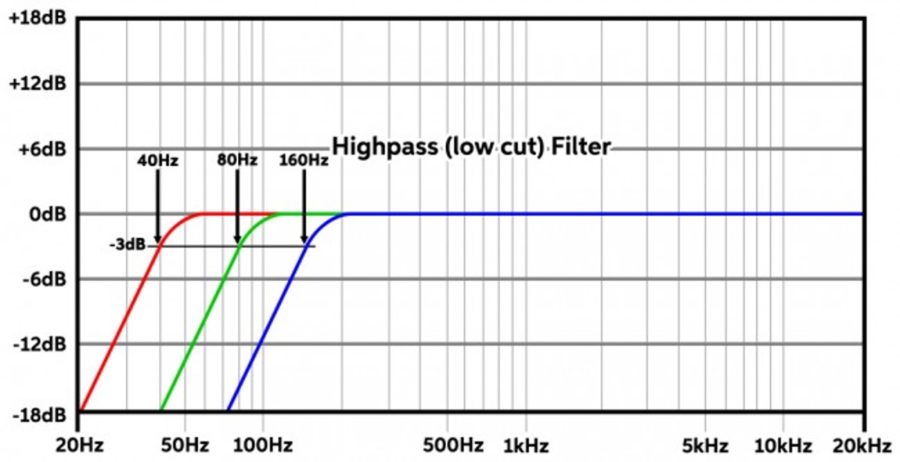
For that high pass filter to work and be downward by– vi db, you lot need to start rolling off at 120 Hz in the nautical chart below and you don't get to –6dB until 70 Hz. This means you are starting most an octave higher (140Hz) to roll off at 70 Hz. Which means you lot are setting your speaking to drib off before the lowest notes of a tenor voice, or the bloom of an acoustic guitar. If your speakers can't handle that, you actually need to be ameliorate.
I borrowed a chart higher up from Sweetwater music, i of my favorite pro audio and musical instrument stores online.
For college quality speakers, you'd want to driblet that frequency to effectually 30 Hz and below. Trying to eliminate truly deep bass means you would demand to begin rolling off above a boot drum in a rock ring at 60 Hz. Really? You spent $10,000-100,000 in some cases to buy speakers that are wonderfully dynamic but to destroy their potent mid-bass response? Which then destroys the midrange…you get the idea.
The negative trade-offs FAR outweigh the practical benefits. Buy a good pair of speakers whatever your upkeep. On a student'southward upkeep, or a young professional? Be resourceful. I love Pro-Ject Audio's lilliputian SPEAKERBOX 5 at around $399 in the U.Southward. They don't have to be crazy expensive. These little beauties sound like music with an incredible soft dome tweeter you can mind to all night. They probably don't make a unmarried annotation of bass beneath 65Hz, simply pair them with a T/5i and you accept an amazing music system with no need to cross out the bass unless you lot want to listen at levels that will get you lot kicked out of your apartment.
So to wrap this up, REL doesn't utilise High Pass Filters. We suggest ownership a decent pair of speakers whatever upkeep y'all're on. And then buy the correct partnering REL, the sonic impact one of our subwoofers delivers is difficult to enlarge.
Now you can get back to enjoying musical and habitation theatre experiences knowing why yous enjoy the rich natural sound we all require.
March 24, 2021 - Posted in: Principles of Sound

What Does A High Pass Filter Do,
Source: https://rel.net/blog/2021-03-24/principles-of-sound/what-is-a-high-pass-filter-and-why-doesnt-rel-use-them/
Posted by: williamloyed1964.blogspot.com
0 Response to "What Does A High Pass Filter Do"
Post a Comment