

Are There Any Animals Bears Are Afraid Of
" The best thing people tin can practise for bears is replace misconceptions with facts." – Dr. Lynn Rogers
Bears have fascinated humans for millennia. As one of the most adaptable and versatile mammals on world, their behaviour stirs fear, awe, wonder, and curiosity in usa. Unfortunately, there are still many myths surrounding the lives and behaviour of bears that negatively impact our relationships with them.
Stories of ferocious attacks past blood-thirsty bears on defenceless hikers make peachy lead stories in the media. The overwhelming sense conveyed in these stories is that bears are dangerous, mean creatures that are an extreme threat to people in any circumstance. This, of form, is inaccurate at all-time and unhelpful at worst.
Another commonly held myth is that bears are cuddly creatures that resemble the teddy bears nosotros endemic as kids. While there is no doubt that bears have the ability to trigger children'southward imaginations, it is of import that the stories we share with our children be based on facts rather than fantasy.
It is important to dispel both myths – the one based on fear, and the other based on a misplaced belief that bears are tame cuddly animals.
Bears are intelligent and resourceful wild mammals that deserve our respect. A greater cognition of the behaviour, ecology and habitat needs of bears is crucial if nosotros are to learn to co-exist peacefully with these magnificent creatures.
Myth #i: Bears are unpredictable
Fact: Bears utilize body language and vocalizations to evidence their intentions. Learning nigh deport behaviour tin can exist beneficial to people who live or recreate in behave country.
Myth #two: Bears tin can't run down colina
Fact: Bears can run more than 60 kilometers an hour, and they can do it upward hills, downwards hills or along a slope. To put that in perspective, that's fifteen m/sec or 50 ft/sec – more than than twice as fast as we can run. In fact, a deport can outrun a racehorse over brusque distances but has little endurance.
Myth #3: A bear standing on its hind legs is about to accuse
Fact: Really, a bear continuing on its hind legs is just trying to better identify what has caught its attention. As I'1000 sure you'll agree, it's much easier to see, hear and aroma things from a standing position, than down on all fours.
Myth #four: Once a bear has tasted human being food, he won't eat wild nutrient whatever more than
Fact: Bears prefer natural, wild food unless it is hard to find and homo food is too like shooting fish in a barrel to get. Fifty-fifty bears that regularly consume human food/waste matter
still consume natural foods whenever they're plentiful. Conflicts usually increment when natural foods run out – a skilful time to be more vigilant of deport attractants on your property; such equally bird feed, pet food, fruit trees/berry bushes, charcoal-broil grease and compost. Click here to learn more near how to become Bear Smart.
Myth #v: Bear bells are the best way to avert a surprise encounter
Fact: Information technology'southward best to alert bears of your presence by talking loudly, singing songs or breaking sticks. Attempt to hike in a group, on established trails, during daylight hours. Run across our Play section for more than information.
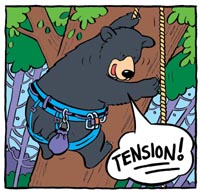
Myth #half-dozen: If a bear charges y'all, climb a tree.
Fact: Despite all their timidness on the footing, black bears seem to feel more than courageous in trees. Bears sometimes kill each other by throwing their opponents out of trees. The acquit beneath has the advantage because the deport above cannot easily hang on and face downward to fight back. Also the lower conduct seems confident of these advantages and some bears accept even come up trees later on people who thought climbing was prudent. Grizzlies, too, tin can climb – perchance not as quickly, merely they have been known to attack people who climbed trees to escape. See our Play section for more information.
Myth #7: Bears are carnivores.
Fact: Although classified in the order carnivora, grizzly and black bears are omnivores considering they eat both plants and animals. Only a small-scale percentage of their diet consist of meat, which includes fish, insects and other mammals (the verbal pct is dependant on the blazon of nutrient is bachelor in their habitat).
Myth #8: Bears accept poor eyesight
Fact: Bears see in colour and have good vision similar to humans. Their night vision is splendid and they are particularly attuned to detecting movement. Like many animals, bears' eyes take a reflective layer called the tapetum lucidum lining the back of the eyeball. This layer reflects lite back through the retina, allowing calorie-free to stimulate low-cal-sensitive cells in the retina a second time, thereby improving dark vision. This is what gives dogs, cats and many nocturnal animals that distinct, bright greenish eyeshine when they are flashed with a light at night.
Myth #ix: Bears that wander into inhabited areas such as campsites, rural towns or cottage communities are dangerous
Fact: Information technology is nearly impossible for a acquit to brand its daily excursions without walking through someone's individual property. Bears may travel hundreds of kilometres in their search for food. If you have stored your nutrient and garbage properly, the comport will likely motion on. Call back, problem bears aren't born, they're created through mismanagement of human food and garbage. If bears are hanging around, something is attracting them. Removing the attraction will usually solve the problem.
Myth #ten: Shooting or relocating a 'nuisance' conduct will solve the problem
Fact: Removing the acquit and not the attractant will only create an opportunity for some other bear to movement in, creating a vicious cycle of disharmonize and killing.
Myth #11: Carrying a rifle is safer than bear spray
Fact: A person's run a risk of incurring serious injury from a charging grizzly doubles when bullets are fired versus when bear spray is used (Dr. Stephen Herrero). Those injured defending themselves with bear spray experienced shorter attacks and less severe injuries than those who chose to apply firearms (United states Fish and Wildlife Service). Click hither to read the full report. Bears are actually attracted to bear spray residue if it is sprayed on the footing or on objects. Never spray it around a tent or on yourself. When used defensively, behave spray must exist sprayed directly in the attacking bear's eyes or olfactory organ. Click here for more information.
Myth #12: Ane of the most unsafe encounters is getting between a mother black conduct and her cubs
Fact: Because black bears tin tree their cubs, information technology is rare for them to attack a person in defence of cubs. Yet, if yous are anywhere near a mother grizzly's cubs, she might very well perceive you as a threat. The chances are good that she volition but bluff charge and stop well short of physical contact. Y'all need to do whatever you can to show her that y'all are not a threat, otherwise the consequences could exist tragic. Be tranquillity, brand yourself smaller and retreat.
Myth #13: People traveling in bear country are often attacked
Fact: Carry attacks are extremely rare. Although in that location are thousands of human-bear encounters every year, only a very few result in personal injury. Near bears will actually retreat earlier you are even aware of their presence. Information technology is even so important, however, to stay alert and know what to do.
Myth #14: It is unsafe to get into carry land when menstruating
Fact: Current evidence suggests that catamenia does not increase the likelihood of an set on by a black or grizzly bear, but tampons are recommended over pads. They may exist disposed of by burning and then packing out the remains.
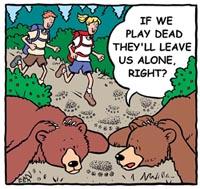
Myth #15: Play dead during an assail.
Fact: Playing dead will work if yous're being attacked by a mother grizzly defending her cubs. But information technology is the wrong thing to exercise if yous're being attacked by a predatory bear. If a bear attacks (peculiarly a black bear) in an offensive mode and concrete contact is made, fight for your life. Kick, punch, hit the bear with rocks or sticks or any improvised weapon you can find. A predatory bear unremarkably stalks its prey and attacks from behind. It is often silent and the bear does not exhibit any defensive behaviors like huffing or slapping the ground. Its ears may be laid back and its caput held low, with its intent focused directly on you. See our Play section for more information.
Source: https://www.bearsmart.com/about-bears/dispelling-myths/
Posted by: williamloyed1964.blogspot.com
0 Response to "Are There Any Animals Bears Are Afraid Of"
Post a Comment